Which crystals make each one, how high the Sun has to be, and where to look. Every sky here is computed; where we have a photograph of the real thing, it sits beside it.
Crystals
01 · Any way up
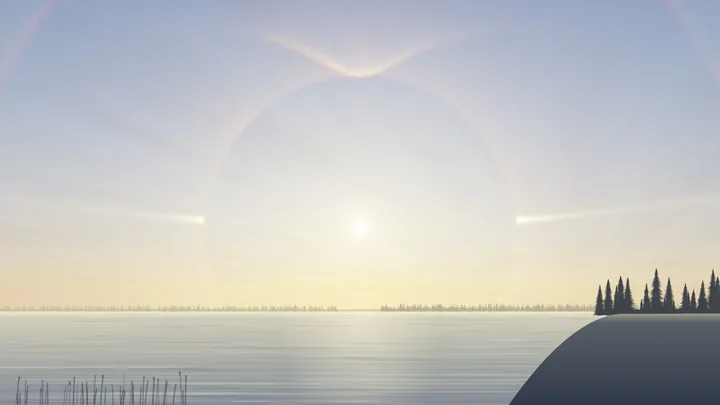
22° halo
ring, moon ring, winter halo
Crystals
Columns, any way up
Sun height
Any Sun height
Where
22° from the Sun: one hand
How often
Common
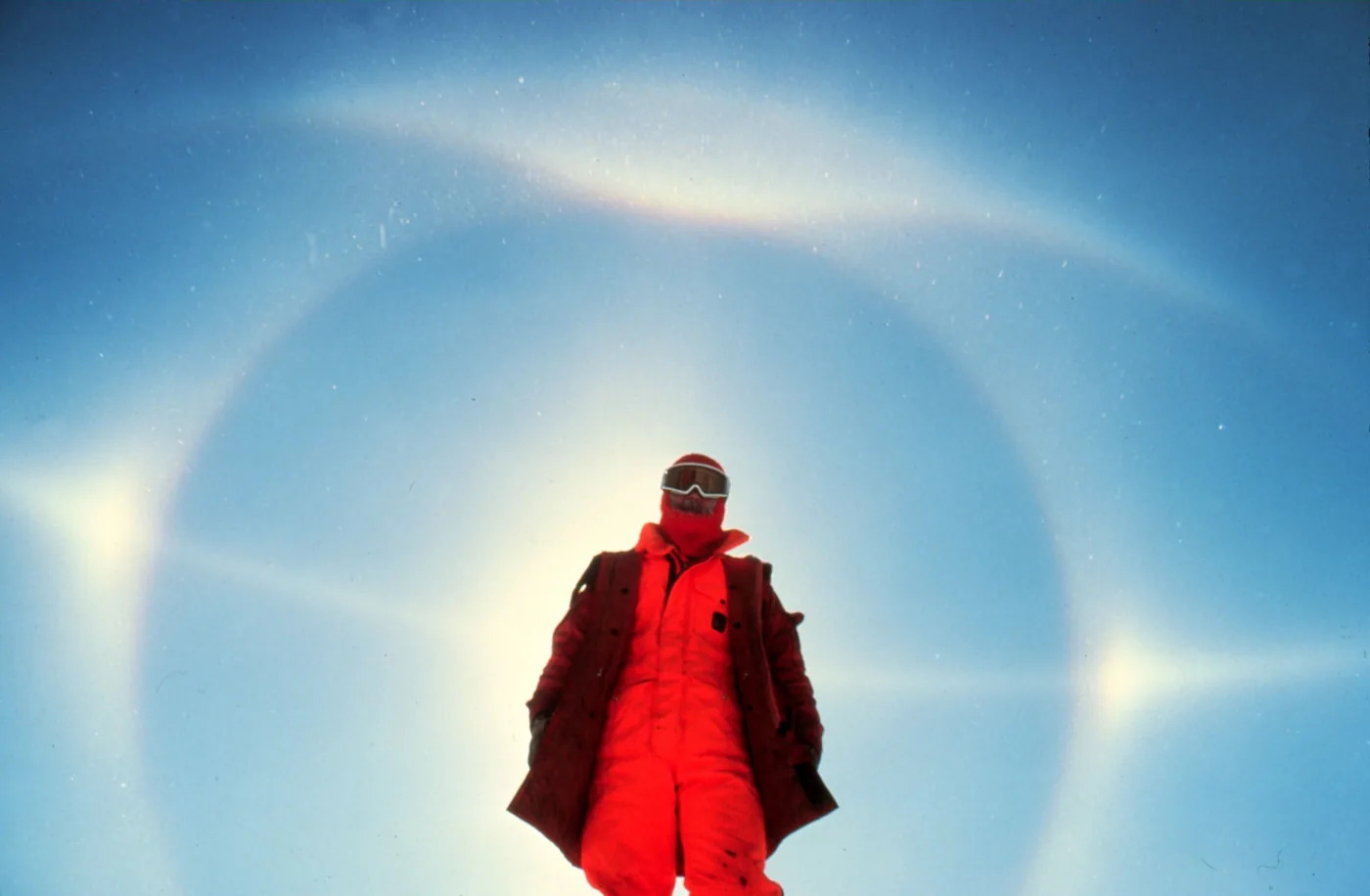
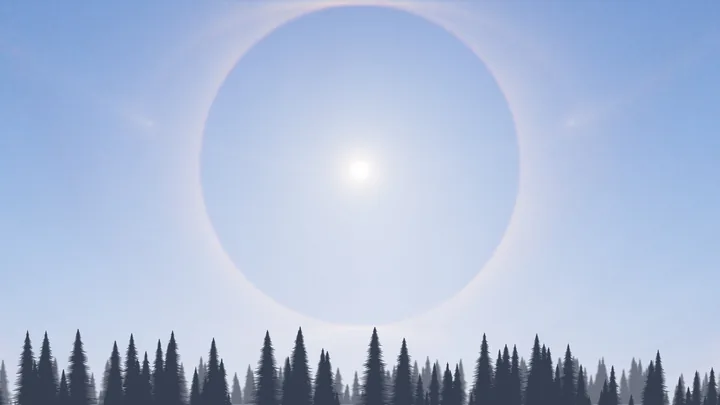
Light crossing two faces of a hexagon that meet at 60° bends at least 21.84°. It piles up there, and none falls inside, so the middle looks darker.
PhotographedSouth Pole, Lt (j.g.) Cindy McFee, NOAA Corps. Public domain
02 · Plates
Sun dogs
parhelia, mock suns
Crystals
Plates floating level
Sun height
Sun below about 61°, best when low
Where
At the Sun’s height, just outside the ring
How often
Common
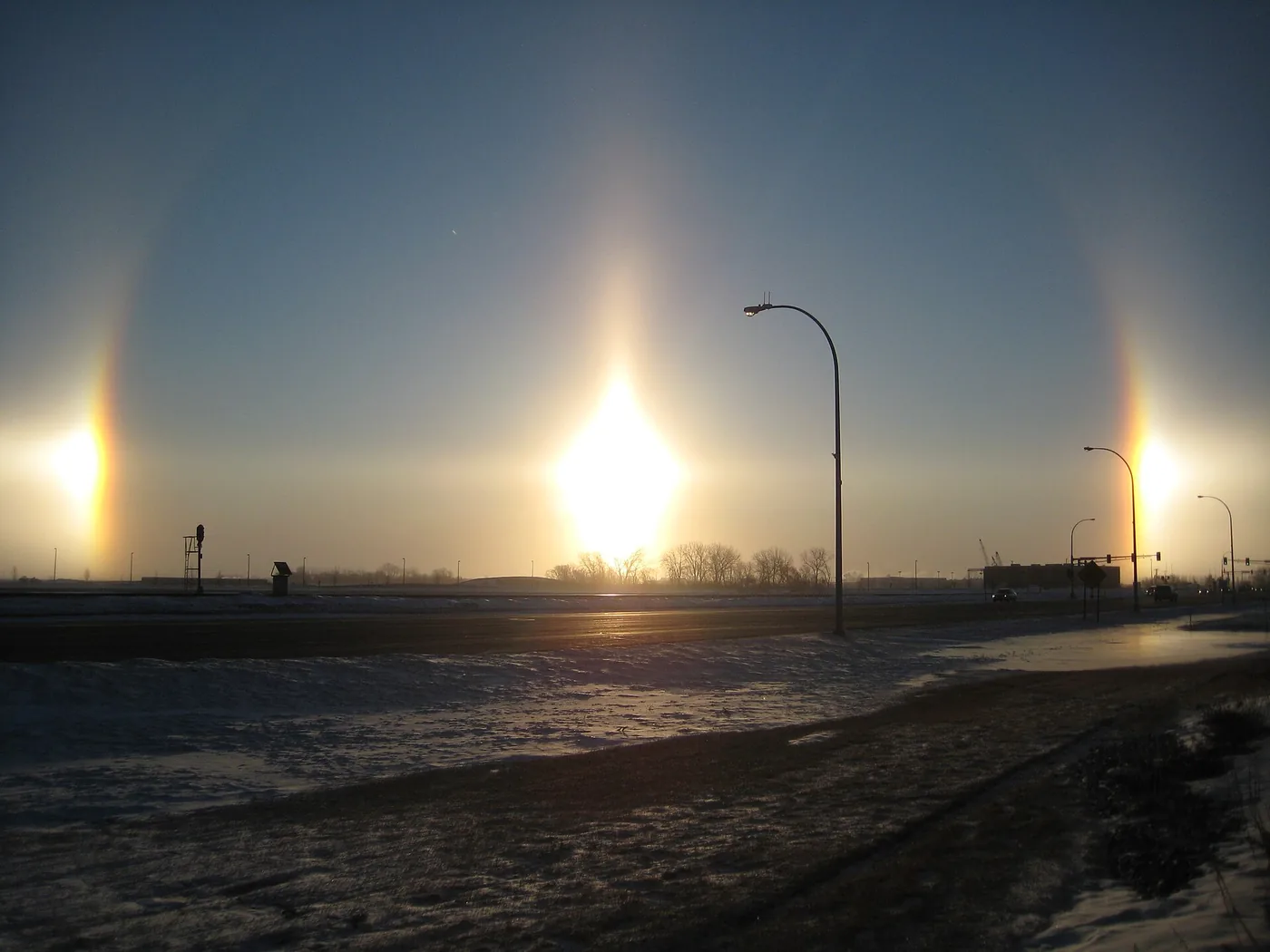
The plates act as 60° prisms for light passing sideways. The higher the Sun, the further out the dogs move: 21.8° at the horizon, 24.8° at 30°.
PhotographedFargo, North Dakota, Gopherboy6956. Public domain
03 · Mirrors
Parhelic circle
Crystals
Vertical faces as mirrors
Sun height
Any Sun height
Where
A white line at the Sun’s height, all round the sky
How often
Less common than sun dogs
Sunlight reflected off the upright faces of plates and columns. It is white because reflection does not split colours.
04 · Plates
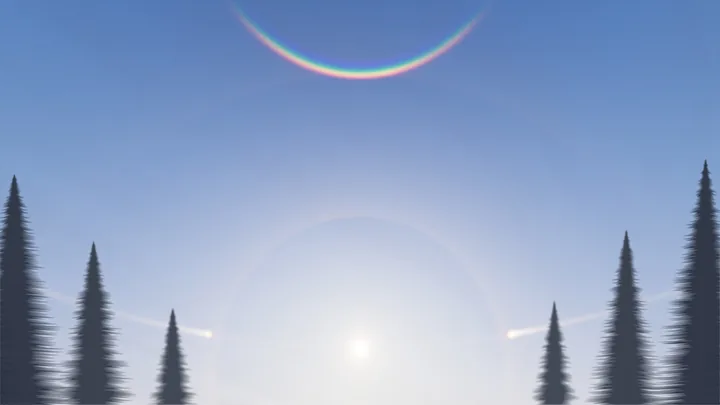
Circumzenithal arc
upside-down rainbow, Bravais arc
Crystals
Plates floating level
Sun height
Sun below 32.2°, brightest at 22°
Where
About 46° above the Sun: two hands
How often
Not rare, just overhead
Light enters a plate’s flat top and leaves through a side: a 90° prism, so the colours separate cleanly, violet on top.
05 · Plates
Circumhorizontal arc
lower 46° plate arc
Crystals
Plates floating level
Sun height
Sun at 58° or higher
Where
46° below the Sun, parallel to the horizon
How often
Summer, south of 55°
Light enters a side face and leaves through the bottom. The Sun never gets that high north of 55°, so Stockholm never sees one; London gets about 140 hours a year.
06 · Columns
Upper tangent arc
circumscribed halo when the Sun is high
Crystals
Columns lying flat
Sun height
Any Sun height
Where
Touching the top of the ring
How often
Fairly common with a bright ring
A sharp V over the Sun when it is low; as the Sun climbs past 29–32° the upper and lower arcs join into one oval round the ring.
07 · Any way up
46° halo
Crystals
Columns, any way up
Sun height
Any Sun height
Where
46° from the Sun: two hands
How often
Rare
Light enters a side face and leaves through an end face, a 90° turn. Larger and fainter than the 22° ring, with its outer edge washed out.
08 · Mirrors
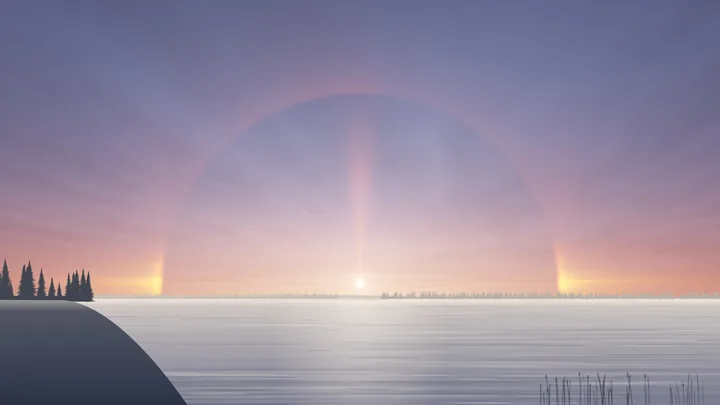
Sun pillar
Crystals
Plates as mirrors
Sun height
Sun within 6° of the horizon (plates), up to 20° (columns)
Where
Straight up from the Sun
How often
Common at sunrise and sunset in cold weather
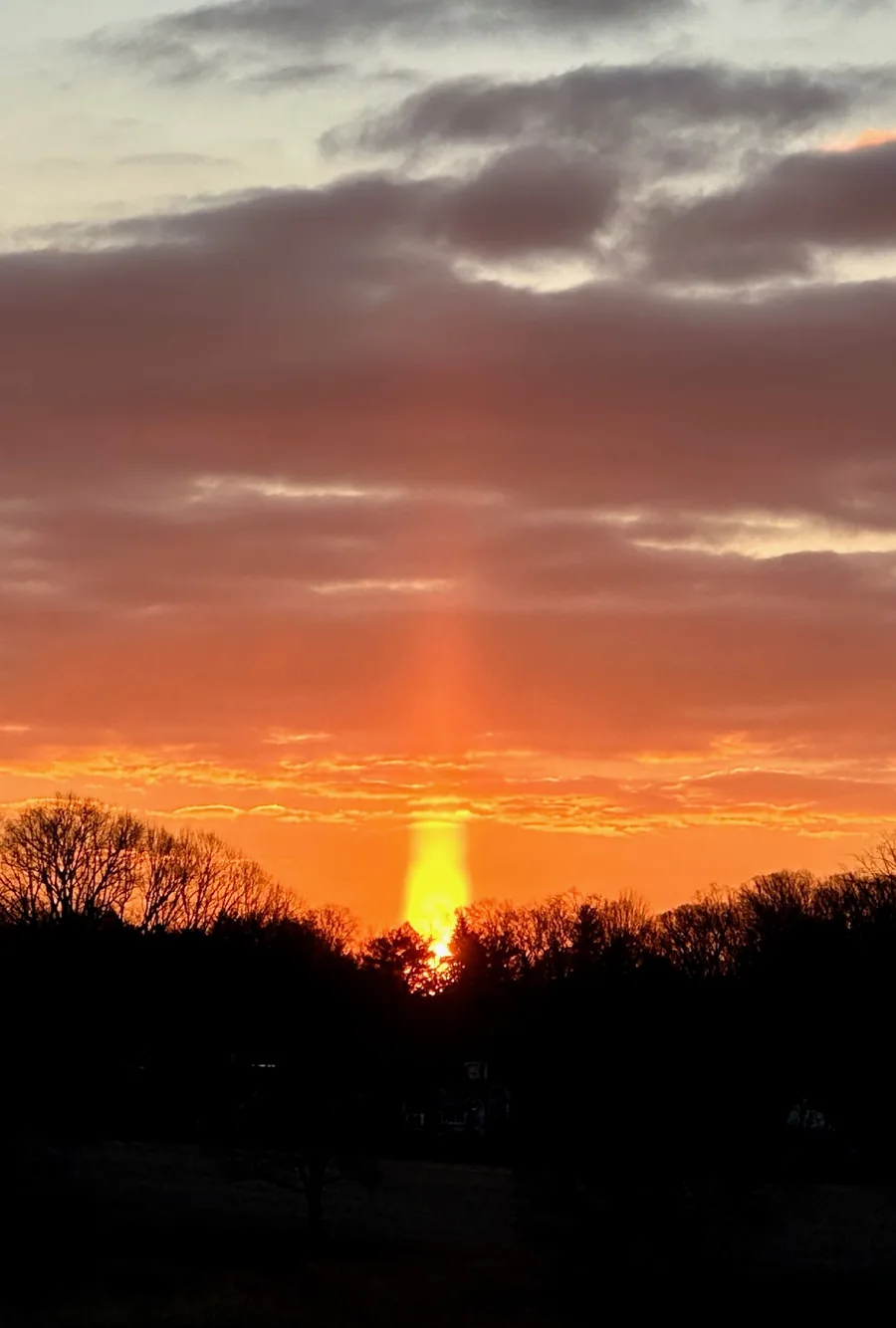
Each plate is a tiny mirror tilted a little. Only the ones in the vertical line between you and the Sun send its light to you.
PhotographedFearless6, 2025. CC0
09 · Mirrors
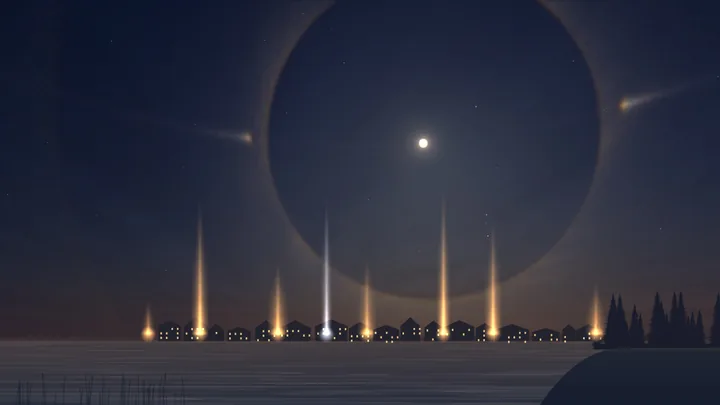
Light pillars
over street lights
Crystals
Plates as mirrors, near the ground
Sun height
Cold, still nights with diamond dust
Where
Above every bright light
How often
Cold nights
The same mirrors as a sun pillar, but the light is close, so the pillars look much taller. The pillar sits between you and the lamp, not over it.
10 · Any way up
Moon ring
paraselenae (moon dogs) with plates
Crystals
Columns, any way up
Sun height
Bright Moon, near full
Where
22° from the Moon
How often
Common
The 22° halo again, in moonlight. Folklore called it a storm ring; the cirrostratus that makes it often runs ahead of a front.
11 · Columns
Parry arc
named for William Edward Parry, 1820
Crystals
Columns lying flat, one pair of faces level
Sun height
Most Sun heights
Where
Over the upper tangent arc
How often
Rare
Columns that keep their axis horizontal and a pair of side faces level: the “Parry orientation”. Why they float that way is still studied.
12 · Plates
Lowitz arcs
named for Tobias Lowitz, 1790
Crystals
Plates spinning about a long diagonal
Sun height
With bright sun dogs
Where
Running inward from the sun dogs
How often
Very rare
Lowitz drew them in St Petersburg in 1790. They were doubted for two hundred years, until small cameras caught them around 1990. How they form is still debated.
Measuring
Degrees, in hands
A hand stretched out at arm’s length spans about 22°: thumb on the Sun, little finger on the ring. Two hands reach the circumzenithal arc and the 46° halo. That is all the instrument most reports need.