MULON Order salt

[Saline de Kervalet · Batz-sur-Mer]

Salt from the
Guérande marsh

MULON is one saline at Kervalet, near Batz-sur-Mer. The sea comes in on the big tides, and from June to September we rake it out of 24 clay pans as fleur de sel and sel gris.

See the saltBook a marsh walk

[Parts of the saline]

    [July]

    [47.278° N · 2.479° W]

    [Harvest: mid-June to mid-September]

    01The saline

    A saline is a staircase of water. Seawater comes in at one end at 3.5% salt, moves from basin to basin as sun and wind take the water away, and reaches the pans at 26%, where it can hold no more and the salt comes out.

    [Halite, hopper form · the edges grow faster than the faces]
    Salt in the water, sea to pan
    3.5% → 26%
    Brine in a pan
    5 mm
    Pans, called œillets
    24
    Salt from one pan a year
    ≈ 1 t

    02Read the water

    The colour
    is the salt

    Each basin is saltier than the last, and the algae and brine shrimp that live in it change its colour. Follow the water from the channel to the pan.

      1. Étier

        The sea comes in on tides above coefficient 80, through a single 500 m gap between Le Croisic and Pen-Bron, and runs up the channels to each saline.

      2. Vasière

        A deep reservoir where the mud carried in by the tide settles out. It is cleaned every winter and holds water in reserve all season.

      3. Cobier

        Only a few centimetres deep. A second settling, and the start of evaporation proper.

      4. Fares

        Long, shallow basins where the salt climbs fastest. Green algae give way to an amber tint as carotene-rich algae and brine shrimp take over.

      5. Adernes

        The strong pink brine waits here and refills the pans after each day of evaporation, through the narrow channels called sauniers.

      6. Œillet

        About 5 mm of brine on a clay floor. At 26% the water holds all the salt it can, and crystals start to form as hollow, stepped cubes.

      Nine tenths of the water has gone before the first crystal forms.

      03Two salts, one pan

      What the pan
      gives

      Fleur de sel

      On warm afternoons with a breeze, a thin crust forms on the surface and drifts to the downwind edge. It is skimmed every evening with the lousse before rain can dissolve it, and it never touches the clay, so it stays white.

      Picked
      Every evening, June–August
      Tool
      Lousse
      Yield
      2–3 kg a day
      Moisture
      Up to 10%
      Grain
      0–4 mm
      Buy fleur de sel

      Sel gris

      Grains that grow on the clay floor of the pan. The paludière pushes the water round with the las, rolls the grains into a ridge at the foot of the ladure and lifts them out to drain overnight.

      Raked
      Daily, then every 2–3 days
      Tool
      Las, beech blade
      Yield
      40–75 kg a day
      Moisture
      About 13%
      Grain
      1–7 mm
      Buy sel gris

      04The year

      A summer
      crop

      Salt is made from mid-June to mid-September. The rest of the year goes on the banks and the mud, and in winter the pans sleep under seawater.

        05The trade

        Fixed in
        the 1400s

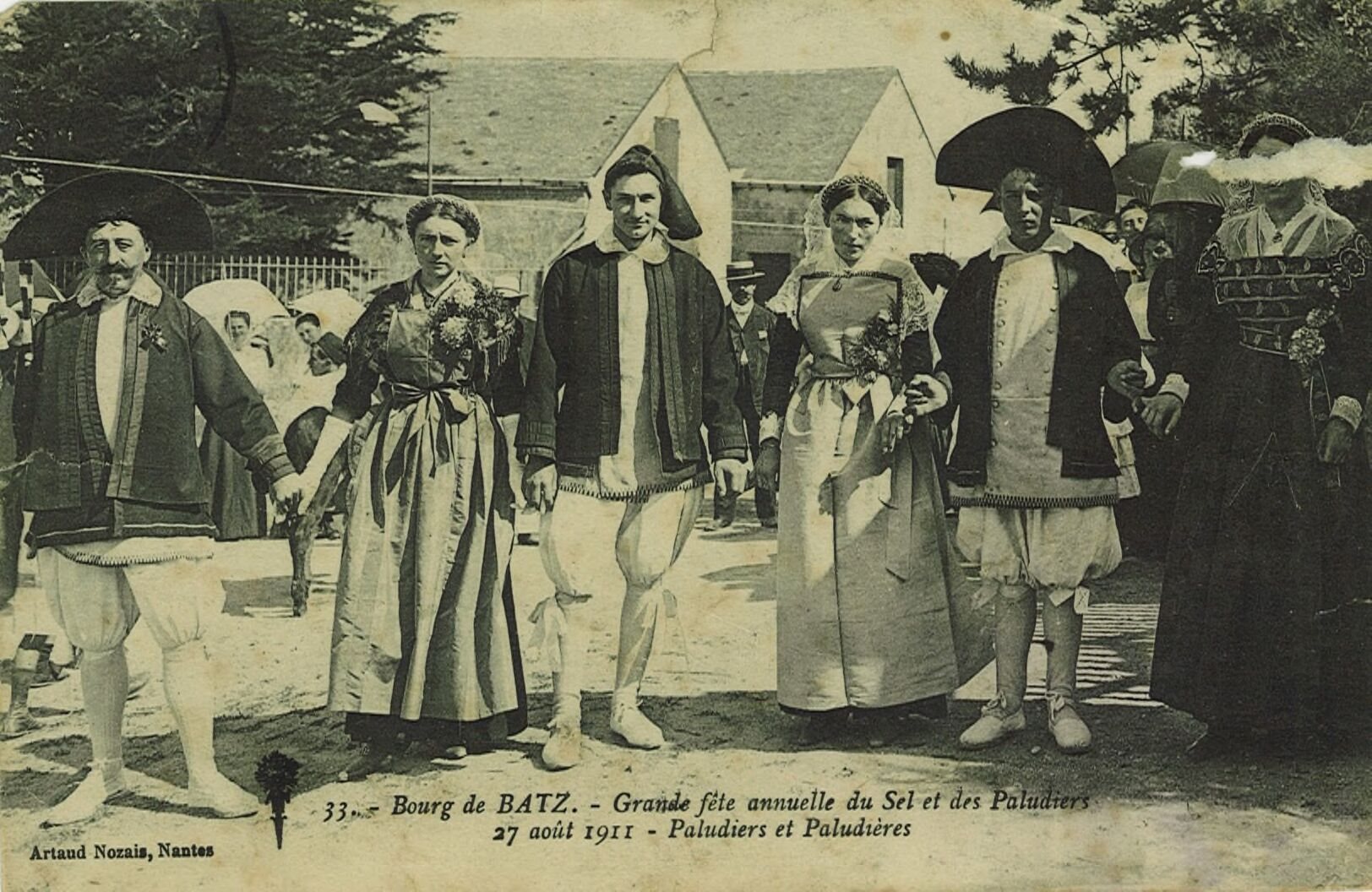
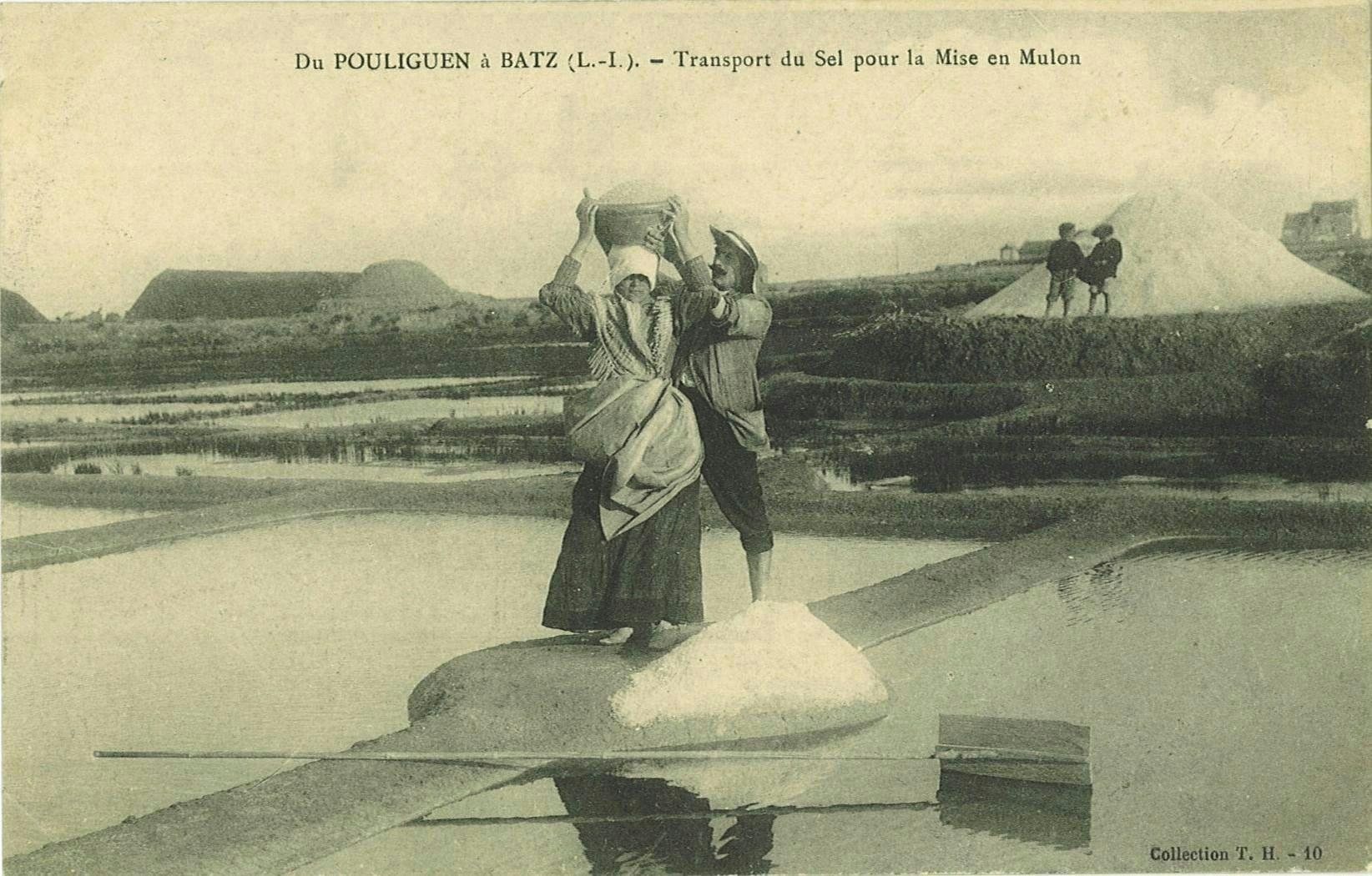
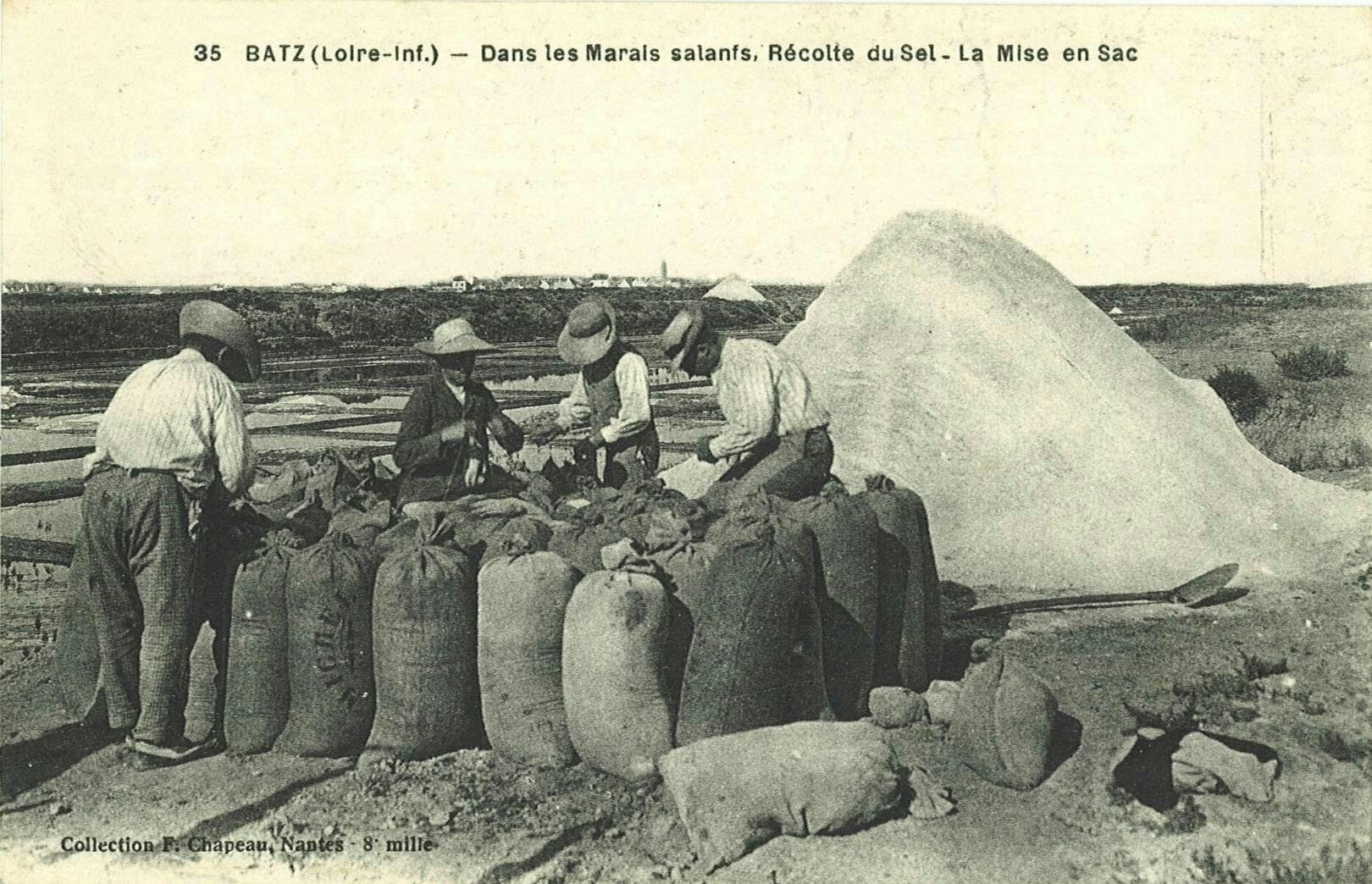
        The way a Guérande saline is worked has hardly changed since the fifteenth century. Postcards from Batz a hundred years ago show the same pans, the same rakes and the mulon growing on the trémet.

        Read the history

        Paludiers and paludières in festival costume at Bourg de Batz, 1911.
        Bourg de Batz, salt festival, 27 Aug 1911
        Postcard: a woman carries a basket of salt on her head along a bank toward the mulon.
        Le Pouliguen–Batz, salt carried to the mulon
        Postcard: paludiers fill sacks of salt beside a large heap.
        Batz, the harvest bagged

        06Walk the saline

        Come at
        harvest time

        Ninety minutes on the banks with the paludière: the water from channel to pan, a prise de sel, and fleur de sel picked in front of you.

        When
        July–August · Tue–Sat · 18:30
        Length
        90 minutes
        Price
        €12 · under-12s free
        Meet
        The salorge, Route de Kervalet
        Group
        14 people at most
        Book a walk