W Widening
How much wider the tube gets in one turn. At 3.15 each turn is three times the last and wraps round them all; at 1.2 a shell needs 23 turns to reach the same size.
Room 1 · The curve
A shell is a tube that grows only at its open end and never changes shape as it gets bigger. That makes its outline a growth spiral: every turn is the last one, scaled up.
The curve on this page: r = ebθ, each turn 2.05 times the one before, the periwinkle's W
Five hundred years of one idea
1525
Albrecht Dürer is the first to describe the curve. He calls it an eternal line, ewige Linie.
1638
René Descartes discusses the same curve, more than a century later.
Later
Jacob Bernoulli names it Spira mirabilis: it grows but never changes shape. He asked for it on his gravestone with Eadem mutata resurgo, "although changed, I shall arise the same". An Archimedean spiral was carved instead, with turns an equal distance apart.
1917
D'Arcy Thompson, Professor of Natural History at University College, Dundee, publishes On Growth and Form, written mostly in 1915. Its 793 pages include the logarithmic spiral of mollusc shells and ruminant horns.
1952
Alan Turing shows how two substances, one boosting itself and the other holding it back, can make stripes and spots from an even start.
1962
1966
David Raup, a palaeontologist at the University of Chicago, describes shells with a few numbers and lets a computer draw them. Many of the combinations were never adopted by any actual gastropod.
1983
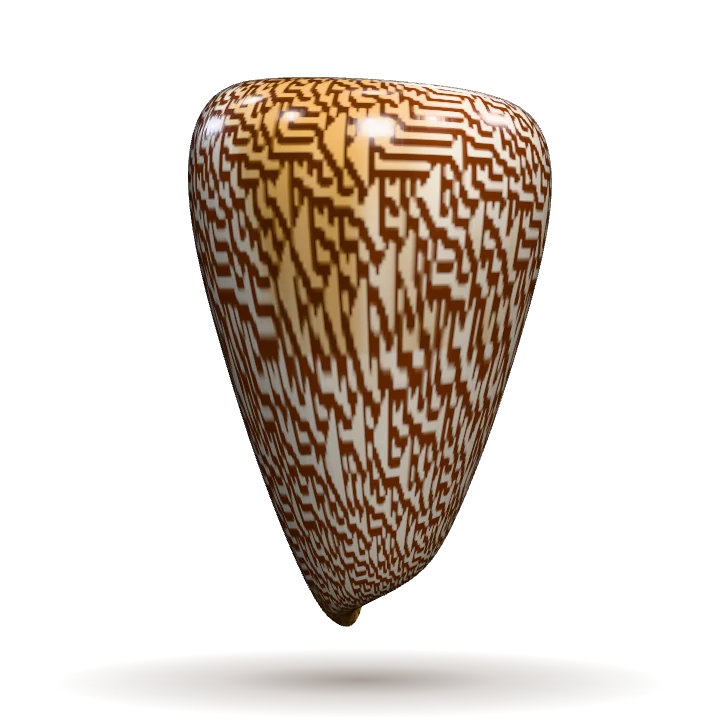
Stephen Wolfram's one-line cellular automaton. The textile cone's shell carries a pattern that resembles it.
Room 2 · Four numbers
How much wider the tube gets in one turn. At 3.15 each turn is three times the last and wraps round them all; at 1.2 a shell needs 23 turns to reach the same size.
How far the opening sits from the coiling axis. At 0 the turns meet at the centre; well away from it they stop touching, as in the ram's horn squid.
How far the opening slides along the axis with each turn. At 0 the shell is a flat coil like an ammonite; at 5.6 it is a tall tower.
The outline of the opening that is swept round. Round for a periwinkle, a tall slit for a cone, an oval with a notch for a whelk's siphonal canal.
Left and right
Hold a snail shell spire up with the opening facing you: in over 90% of species the opening is on the right. A photograph flipped by mistake turns a common shell into a rare left-handed one.
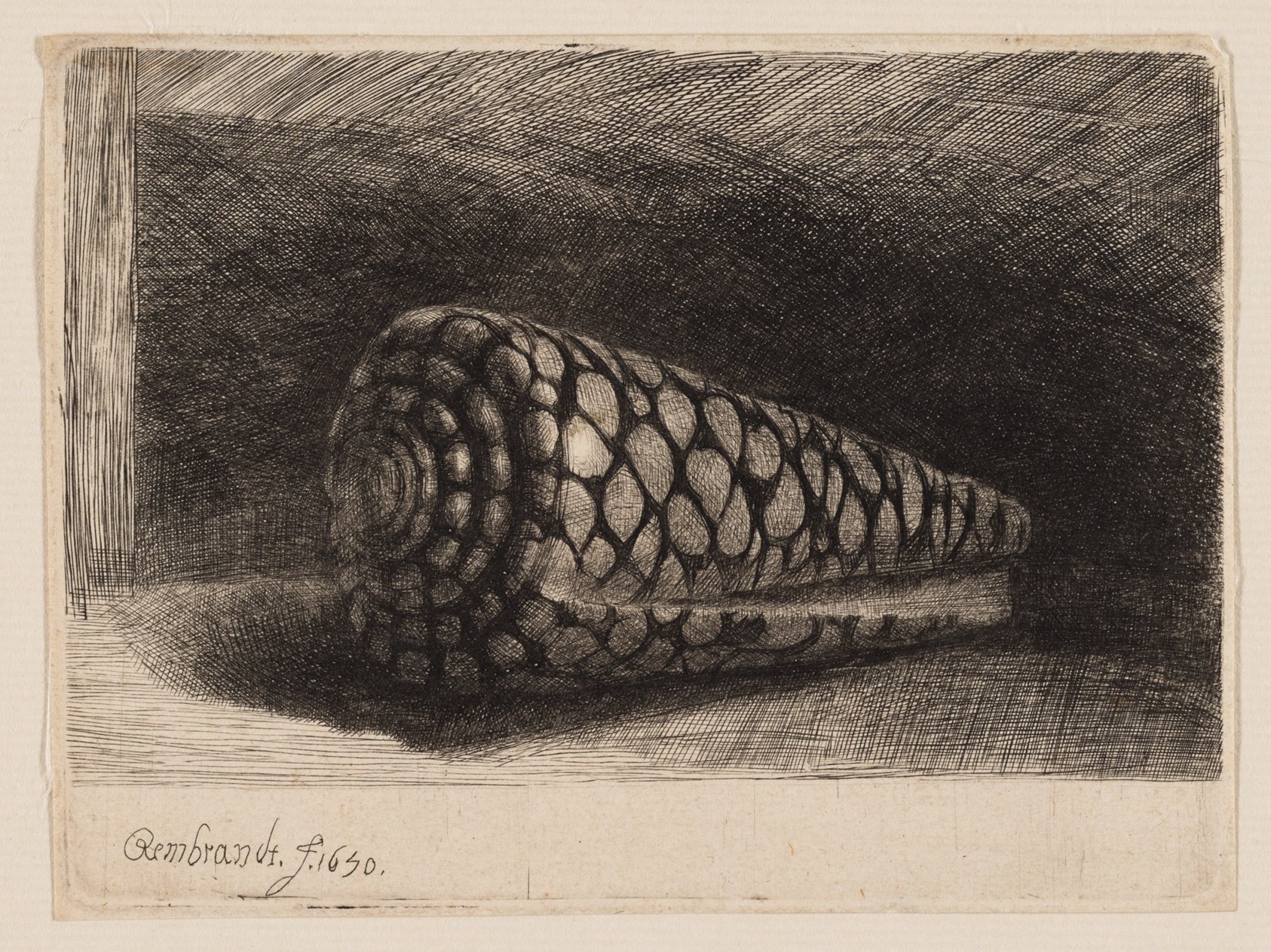
An etching prints the plate in reverse. Rembrandt's signature reads the right way round, but his cone coils to the left. In one land snail, Amphidromus perversus, left- and right-handed shells live side by side.
Room 4 · The empty cube
Two of the four numbers, the twelve shells placed by our model's settings. Raup found that real shells crowd into a few regions of the space of possible shapes. The rest is empty.
Room 3 · The paint
Pigment cells sit in a narrow band along the lip. Each one makes pigment or not depending on its neighbours, and the band leaves its pattern behind as the shell grows. On the textile cone the result looks like Rule 30:
new cell = left XOR (centre OR right)