Companion rescue
Fifteen minutes
Five steps, from the moment the slope moves to a cleared face. Your group does all of them, because the first 15 minutes decide it.
1
Watch, then mark
Keep your eyes on the person in the slide until the snow stops. Mark the spot where you last saw them with a pole or a ski: the search starts below it. Check the slope above you before you step onto the deposit.
2
Signal search
Everyone switches their transceiver to search. In search mode it can pick up a buried unit up to 80 m away. Walk below the last-seen point until the first signal, then follow the arrow: the line it gives you is the curved field line of the buried transceiver, so the path bends.
3
Fine search
Inside the last few metres, slow down. Hold the transceiver low over the snow and bracket: move along one line, stop at the lowest number, then cross at right angles. Mark the lowest reading.
4
Probe
Probe at right angles to the slope, in a spiral out from the mark, until you hit something soft. Leave the probe in. With two buried, probe both and dig the shallowest first: survival more than 2 m deep is rare.
5
Dig
Debris sets hard as it stops, so shovelling is the longest part. Start downhill of the probe, dig in a V with one person behind the other, move snow, not yourselves. Clear the face and the airway first, then call for help.
Why the clock matters
Survival falls fastest in the first half hour. In a Swiss study of 422 buried skiers, 92 % of those dug out within 15 minutes were alive, against about 30 % after 35 minutes. In France a helicopter team typically needs 45 minutes to arrive.
The minimum kit
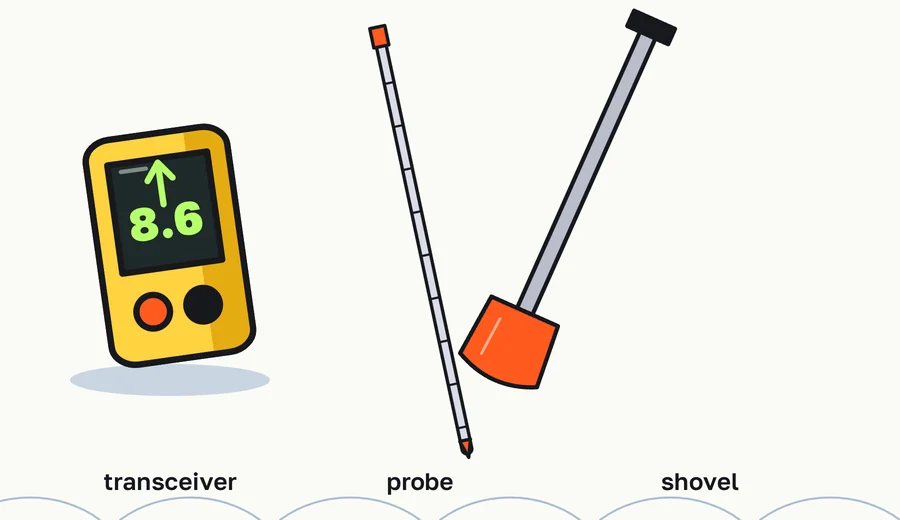
Transceiver, probe and shovel, carried by everyone in the group and switched on at the car park.
- Transceiver
- 457 kHz, the international standard since 1986. Digital units show a distance and an arrow.
- Probe
- Folds into the pack, extends to pinpoint someone metres down. It turns a reading into a hit.
- Shovel
- Metal blade. Snow from a slide is too dense to dig with hands or skis.
Facts: Avalanche transceiver, Avalanche rescue.
Practise it on a deposit