Steel
From a clay furnace to a hardened edge
Five stages, the numbers behind each, and what a smith can and cannot control. Facts on this page come from the sources listed at the end.
Tatara
Tamahagane, "jewel steel", is smelted from iron sand and pine charcoal in a tatara: a clay tub about 1.1 m tall, 3 m long and 1.1 m wide. Sand goes in every ten minutes for about 72 hours. At the end the furnace is broken to take out the bloom.
9.1 tiron sand (satetsu)
11 tcharcoal
72 hof firing, 4–5 people
2.3 tbloom (kera)
< 1 ttamahagane
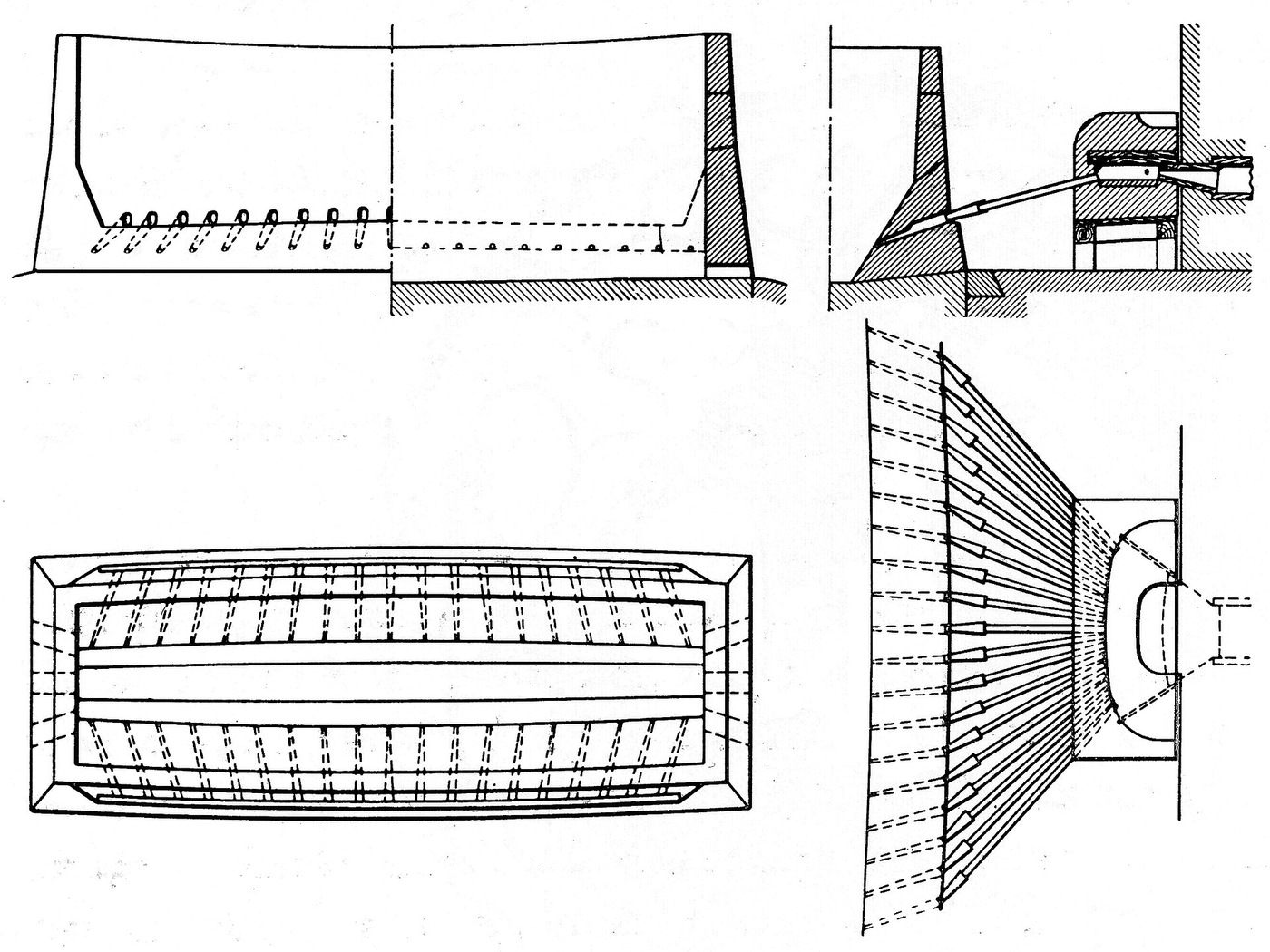
Tatara smelting stopped in the 1920s. In 1977 the Society for Preservation of Japanese Art Swords rebuilt one in Shimane; it runs only in winter, three or four times a year, and sells its steel only to master smiths.
Folding
The bloom is broken, sorted by its fracture, and the pieces stacked and welded into one billet (age-kitae). Then: draw it out, cut, fold, weld again (shita-kitae), 8 to 16 times. Each fold doubles the layers.
Each panel is the same billet after a number of folds. The model follows the baker's map, the mathematics the folding is usually compared to, and lets carbon diffuse a little between layers at every heat; by ten folds the layers are finer than the eye can follow.
Construction
High-quality blades are often not one steel. A harder skin is folded into a U around a soft, low-carbon core and the two are drawn out together, so the edge is hard and the body can bend.
Clay, then hamon
Before the quench the smith paints the blade with clay: thick on the spine, thin on the edge. Thin clay cools fast and turns to hard martensite; under thick clay the steel stays soft pearlite. The line between them is the hamon, so the hamon is drawn in clay first.
The quench
Yaki-ire is done in a dark smithy, traditionally at night, so the smith can judge the heat by colour: the blade should glow like "the moon in February and August". It goes into the water edge down, point first.
The edge cools first and the blade bends toward it; then the hot spine contracts and pulls it the other way. That is where the curve comes from. Edge about 58–60 HRC, spine about 40.
The tang
The smith files the tang, cuts the mei (signature) and sends the blade to a polisher. The tang is never cleaned: its rust shows how the steel has aged, and cleaning it can halve a sword's value.
- ichi-monji
- ko-sujikai
- sujikai
- ō-sujikai
- katte-agari
- taka-no-ha
- higaki
- kesho-yasuri
The rules
- Licensed smiths only. A smith needs a licence and a five-year apprenticeship.
- Two long swords a month. 24 a year per smith, set to protect quality.
- Every sword is registered. Each blade made in Japan is recorded with the government.